







Your browser does not support the video tag.
Contact us
Services
AI Quickstarts

AI Quickstart

Your AI model, up and running within 6 weeks.

Deploy a biological foundation model in your environment (cloud, on-prem, DNAnexus) within six weeks — with working notebooks, canary tests, and full documentation handed off as artifacts your team owns.

See How It Works

Your Challenges

AI aspirations,
but no clear place to start.
Your leadership wants traction on foundation models. Your team has read the Tahoe-x1, Geneformer, ESM-2, and Evo-2 papers. Picking one, deploying it, and showing initial results still looks like a multi-month project.
Integration with your existing stack, not a parallel one.
The foundation model is one component. Wiring it into your data, your cloud, your GPU quotas, and your existing pipelines is where the months go — and it's where off-the-shelf options tend to stop short.
Internal expertise that's hard to assemble on a deadline.
Getting foundation-model inference into production for biological use cases requires coordinated ML, bioinformatics, and cloud expertise—plus awareness of failure modes that emerge across deployments and data types..

Our Approach

Defined inputs, defined deliverables, defined price.
Clarity on outcomes from the start—so your team can plan, execute, and realize value without uncertainty.
On your infrastructure,
under your control.
We deploy to your on-prem cluster or cloud ( AWS, Azure, GCP, DNAnexus), delivering operational artifacts your team can run, extend, and own.
Environment, not findings.
A working foundation-model environment with executable notebooks—ready for your team to run, reuse, and extend from day one.
Our Services
Reproducible Foundation-Model Deployment.
Deploy and evaluate biological foundation models on your infrastructure in six weeks, with executable notebooks, benchmarked performance, and full methodological transparency.
Scoping conversation in week 1 against your use case and data; containerized deployment of the recommended model in weeks 2 through 4.
Current model menu:Tahoe-x1 (perturbation and cell-state work), Geneformer (cell-type annotation), ESM-2 (protein representation), Evo-2 (genomic sequence modeling), scGPT (single-cell representation and cross-cell inference), AlphaFold2 (protein structure prediction). All open-weight, pulled from canonical sources with version pinning and provenance.
Benefit: You commit to foundation-model adoption without committing to a specific model before you've scoped the biology.
Scoping conversation in week 1 against your use case and data; containerized deployment of the recommended model in weeks 2 through 4.
Current model menu:Tahoe-x1 (perturbation and cell-state work), Geneformer (cell-type annotation), ESM-2 (protein representation), Evo-2 (genomic sequence modeling), scGPT (single-cell representation and cross-cell inference), AlphaFold2 (protein structure prediction). All open-weight, pulled from canonical sources with version pinning and provenance.
Benefit: You commit to foundation-model adoption without committing to a specific model before you've scoped the biology.
Working end-to-end notebooks parameterized for your data, covering the workflows the deployed model supports: embedding generation, cell-state queries, perturbation lookups, or sequence and structure workflows as applicable. Optional template notebooks for evidence integration against Open Targets, GTEx, and pathway databases.
Benefit: Your scientists have a starting point they can modify, not a tutorial they have to translate into their workflow.
Canary notebooks that validate endpoint outputs against reference inputs on a schedule, so you know when the deployment drifts. Evaluation report reproducing the published benchmarks on your deployment; optional benchmarking against your internal reference data.
Benefit: A deployment you can trust six months from now, not just at handoff.
You are in control. We do not host any component of the deployment. The artifacts — container definitions, deployment scripts, notebooks, evaluation report, documentation — go into your git repository. This ensures your team has full ownership and the ability to operate, extend, and scale the system independently from day one.
Scoping conversation in week 1 against your use case and data; containerized deployment of the recommended model in weeks 2 through 4.
Current model menu:Tahoe-x1 (perturbation and cell-state work), Geneformer (cell-type annotation), ESM-2 (protein representation), Evo-2 (genomic sequence modeling), scGPT (single-cell representation and cross-cell inference), AlphaFold2 (protein structure prediction). All open-weight, pulled from canonical sources with version pinning and provenance.
Benefit: You commit to foundation-model adoption without committing to a specific model before you've scoped the biology.
Working end-to-end notebooks parameterized for your data, covering the workflows the deployed model supports: embedding generation, cell-state queries, perturbation lookups, or sequence and structure workflows as applicable. Optional template notebooks for evidence integration against Open Targets, GTEx, and pathway databases.
Benefit: Your scientists have a starting point they can modify, not a tutorial they have to translate into their workflow.
Canary notebooks that validate endpoint outputs against reference inputs on a schedule, so you know when the deployment drifts. Evaluation report reproducing the published benchmarks on your deployment; optional benchmarking against your internal reference data.
Benefit: A deployment you can trust six months from now, not just at handoff.
You are in control. We do not host any component of the deployment. The artifacts — container definitions, deployment scripts, notebooks, evaluation report, documentation — go into your git repository. This ensures your team has full ownership and the ability to operate, extend, and scale the system independently from day one.

How It Works

Built for Immediate Scientific Use
We deliver working notebooks and validated results tailored to your biological context—ready for your team to run, inspect, and extend.
Fixed Scope. 6-week engagement.
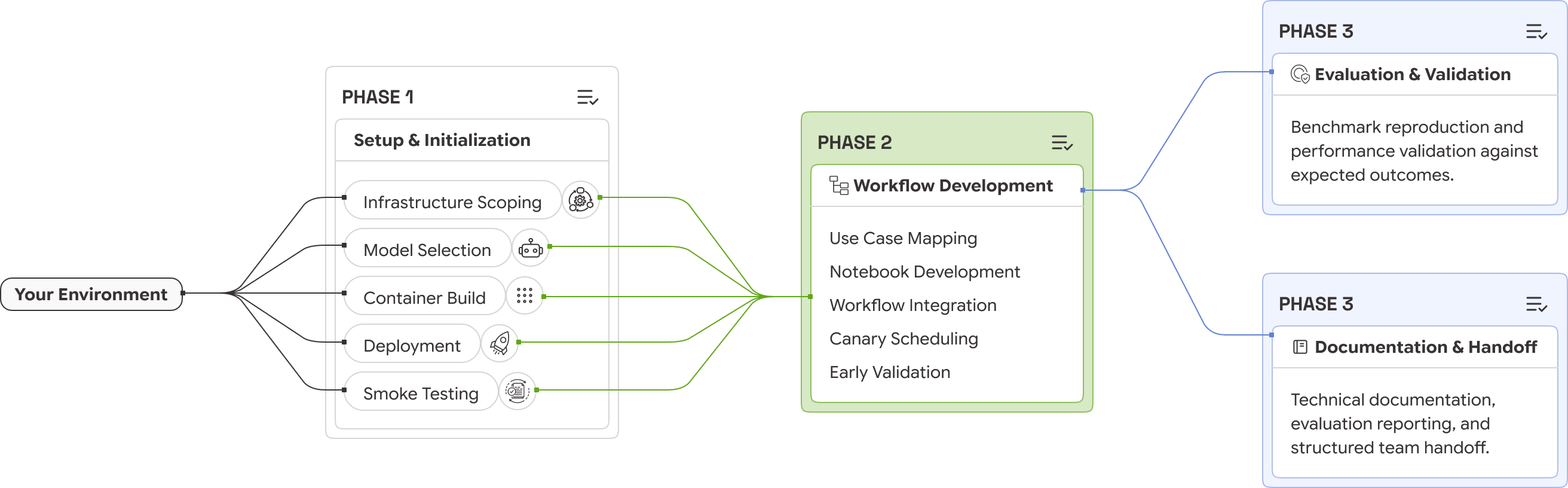
Workflow Diagram
Fixed Scope.
6-week engagement.
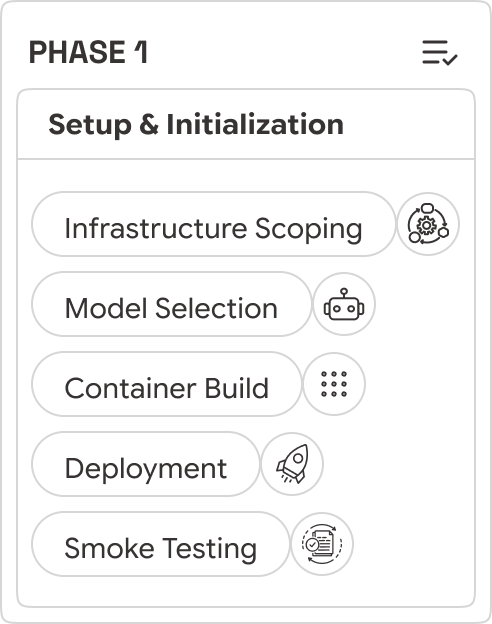
Weeks 1-2
Working inference environment on your infrastructure; models selected, deployed, & validated.
Phase 1
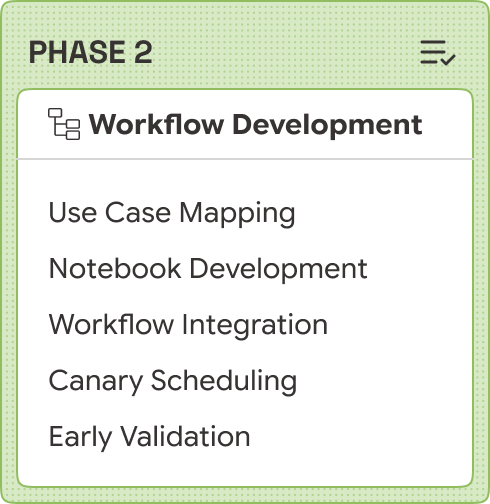
Weeks 3-4
Reproducible notebooks tailored to your biology; initial workflows running on schedule.
Phase 2
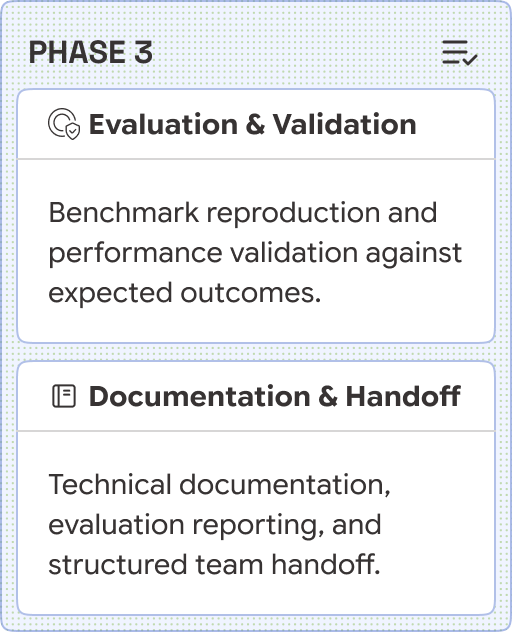
Weeks 5-6
Reproducible notebooks tailored to your biology; initial workflows running on schedule.
Phase 3

FOUNDATION MODELS

Open-Weight Models, Selected for Biological Relevance.

We work with you to select state-of-the-art biological foundation models based on your specific use case and data. Models are open-weight, version-pinned, and deployed with full provenance to support reproducibility.

  • Tahoe-x1 — perturbation modeling and cell-state analysis
  • Geneformer — cell-type annotation and transcriptomic representation
  • ESM-2 — protein sequence and structure representation
  • Evo-2 — genomic sequence modeling
  • AlphaFold — protein structure prediction

Benefit: Evaluate and deploy leading foundation models in your environment—without upfront commitment or integration overhead.

Tahoe-x1GeneformerEvo-2
SCGPTAlphaFoldESM-2

DEPLOYMENT ENVIRONMENTS

Cloud and On-Prem, Aligned to Your Infrastructure..

We deploy foundation-model environments directly into your existing infrastructure, selecting the appropriate platform based on your data, compute, and operational requirements.

AWSGoogle CloudMicrosoft AzureDNAnexus
Your browser does not support the video tag.

Define your AI Quickstart and align on scope, timelines, and outcomes.

Real-world Impact
AI Quickstart: Structure-Based Drug Design, Delivered on DNAnexus
Enabled a scalable AlphaFold and ML-based docking environment that DNAnexus now offers to pharma customers as a production-ready capability.
Real-world Impact
AI Quickstart: Structure-Based Drug Design, Delivered on DNAnexus
Enabled a scalable AlphaFold and ML-based docking environment that DNAnexus now offers to pharma customers as a production-ready capability.

Why DataXight

Foundation Models, Applied

We select, configure, and evaluate models against your specific biological question.

Fixed Scope, Full Transparency

Six-week engagement, defined deliverables. You know what you're getting and when.

You Own Everything

Containerized environments, documented notebooks, evaluated outputs. Nothing is locked behind our platform.

Cross-Disciplinary Depth

Our team spans computational biology, ML engineering, and cloud infrastructure, so engagements don't stall at the handoff between disciplines.

AI Quickstart
FAQs

Have questions? We're here to help.
Any more questions?
Weeks 1–2: infrastructure scoping, model selection, container build, deployment and smoke tests. Weeks 3–4: example notebooks built against your biological context; canary notebooks scheduled. Weeks 5–6: benchmark reproduction, evaluation report, documentation, working session with your team.
Container definitions, deployment scripts, all notebooks, the evaluation report, and documentation — in a git repository you control. Model weights are open-source and pulled directly from canonical sources. Nothing in the pipeline depends on DataXight infrastructure after handoff.
In Week 1 of the engagement, we walk through your use cases, data, and downstream workflows, and recommend accordingly. Scoping is included; you're not committing to a specific model before kickoff. Tahoe-x1 is the most common recommendation for teams working on perturbation response, cell-state characterization, or cancer-relevant single-cell work — it's state-of-the-art on DepMap gene essentiality and MSigDB hallmark oncogenic program inference, and it's perturbation-trained on Tahoe-100M.
Cloud account with GPU access (A100 or H100 preferred; A10G or L4 workable for smaller workloads), container registry, and IAM sufficient for deployment into a sandbox project or compartment. We'll scope exact requirements in week 1.
Yes, with an extended timeline, likely an additional 1–2 weeks. Model weights and container layers would need to be mirrored into your internal registry.
QuickStart's 6-week engagement delivers only the base model running inference. Fine-tuning can be scoped separately as a follow-on engagement, once the base deployment is stable.

Find out what’s happening

More articles
Comparing Perturbations: E-distance and Euclidean distance are Your Best Allies
{Sci-tech}
7 mins read

Comparing Perturbations: E-distance and Euclidean distance are Your Best Allies


Summary Our benchmarking reveals a surprising truth: in the race to translate massive perturbation datasets into discovery, the most effective mathematical "lens" isn't the most complex one. While sophisticated metrics like Wasserstein or Mean Pairwise are often favored due to their mathematical impressiveness, we found that E-distance and Euclidean distance provide the superior balance of speed and signal resolution for high-throughput pipelines. By delivering sharper biological contrast at a

Learn more
Perturbation effect is not an on-off switch
{Sci-tech}
5 mins read

Perturbation effect is not an on-off switch


In this blog, we examine how the “perturbation effect” can vary depending on the metrics used to define it, and why these differences matter. While these metrics may appear interchangeable, they often capture fundamentally different aspects of the underlying biology. As Perturb-seq datasets continue to grow exponentially, understanding how perturbation effects are measured becomes critical for reliable downstream analysis. When suppression is not an on-off switch In 2025, Nadig and colleagues

Learn more
Globally Integrated, Strategically Aligned
{Insights}
2 mins read

Globally Integrated, Strategically Aligned


The most effective technology organizations today are no longer defined by a single geography. They are defined by how intelligently tech companies combine them. In 2026, global tech leadership is about assembling complementary capability — not concentrating everything in one market. That’s where Vietnam, Thailand, and mature tech hubs across the UK, US, and Europe align around real customer needs. US, UK, and Europe: Leadership, and Domain Depth Established tech markets across the US, the UK,

Learn more
More articles

Swipe to Explore

Have an idea?
Drop us a line
Contact Now
DataXight

[Community}

Stay up to date on Dataxight News,
projects, and more

{Follow us}

{Spotlight}

  • Champions Oncology
  • Crown Bioscience
  • Danaher
  • DNAnexus
  • Form Bio
  • UPenn

{Solutions}

  • Data Services & Solutions
  • Software & AI/ML
  • Science Services
  • AI Quickstart

{Products}

  • protoXell
  • protoPlast

{Company Info}

  • About Us
  • Blog
  • Join Us

{Follow us}


© 2026 DataXight
Privacy|Terms of Use
Mountain ViewPragueSai GonBangkok